
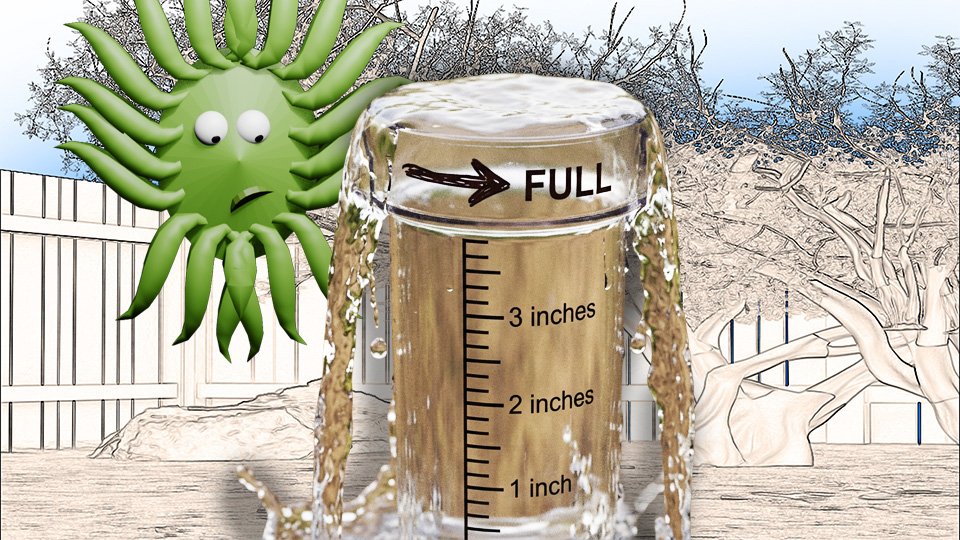
The rain gauge is not exciting. It does not have a motor or a blade or a telescoping handle. It is a tube with measurements on the side that you stick in the ground and check after it rains.
It is also the tool that answers the question every garden watering decision depends on: did it rain enough this week, or do I need to supplement?
Without a rain gauge, this question gets answered by weather app, by memory, by looking at the ground, and by a general sense of whether it felt like it rained. None of these are accurate. The rain gauge is.
🤔 Why You Can’t Estimate Rainfall
The amount of rain that falls during a storm is highly variable and counterintuitive. A storm that sounds impressive, that keeps you inside, that you would describe as “good rain,” may have delivered a quarter inch. A steady drizzle that barely seemed worth a coat may have delivered three-quarters of an inch over several hours.
The weather app is not your garden. It reports precipitation at the nearest weather station, which may be several miles away in a different microclimate. Localized storm patterns mean your garden and the weather station can receive meaningfully different amounts.
Garden plants need approximately one inch per week. Knowing whether this week’s rain delivered that inch, or half of it, or twice it, is the difference between watering correctly and either over or under supplementing.
📏 How to Use One
Place the gauge in an open area of the garden — away from trees, overhangs, or anything that would block or funnel rain into it artificially. After each rain event, read the measurement. Reset it to zero.
Track weekly totals. If the week’s rainfall reaches one inch, you don’t need to irrigate. If it reaches half an inch, supplement with half an inch from the hose. If it reaches nothing, your plants have been depending on stored soil moisture and need attention.
The math is simple and the information is completely reliable. It’s a tube with numbers on it that has been solving this problem since the seventeenth century.
🔧 Types of Rain Gauges
- Standard tube gauge. A cylinder mounted on a stake, open at the top, with measurement markings. Read it manually after rain. Costs upwards of fifteen dollars. Completely accurate.
- Digital gauge with wireless display. Collects data at the garden location and transmits to an indoor display. Some record totals and provide weekly summaries. More convenient for those who don’t want to walk to the garden to check.
- Tipping bucket gauge. An automated gauge that counts incremental rainfall amounts electronically. More sophisticated than most home gardeners need, but accurate and low-maintenance.
For most home gardeners, the fifteen-dollar tube gauge is all that’s needed. Its simplicity is its advantage. Nothing to charge, nothing to calibrate, nothing to go wrong.
🛒 Worth Buying
- Standard rain gauge with stake — The uncomplicated solution. Accurate, inexpensive, lasts indefinitely.
- Digital wireless rain gauge — For those who prefer to check rainfall from the kitchen window. Records totals and provides easy readings.
- Weather station with rain gauge — For the gardener who wants temperature, humidity, and rainfall in one device. More than most people need. Exactly what some people want.
As an Amazon affiliate, I earn with each qualifying purchase. Thank you for support TangleWicket.
✨ The Short Version
A rain gauge costs ten dollars and answers the one question every watering decision depends on. It is the most underrated tool in the garden by a significant margin.
Put it in an open spot. Check it after rain. Add up the week. Water only what nature didn’t provide.
Tom Brownthumb estimated rainfall by feel for three seasons. His estimates were wrong approximately seventy percent of the time. The fifteen-dollar tube fixed this.
📚 Related Reads
- How Much Water Does a Garden Actually Need?
- Morning vs. Evening Watering: Does It Actually Matter?
- Building a Simple Rain Barrel System
TangleWicket is part of the WhistleBump group – find the rest of the family at WhistleBump.com.
32007
©2026 John D Reinhart/Tanglewicket.com – all rights reserved