
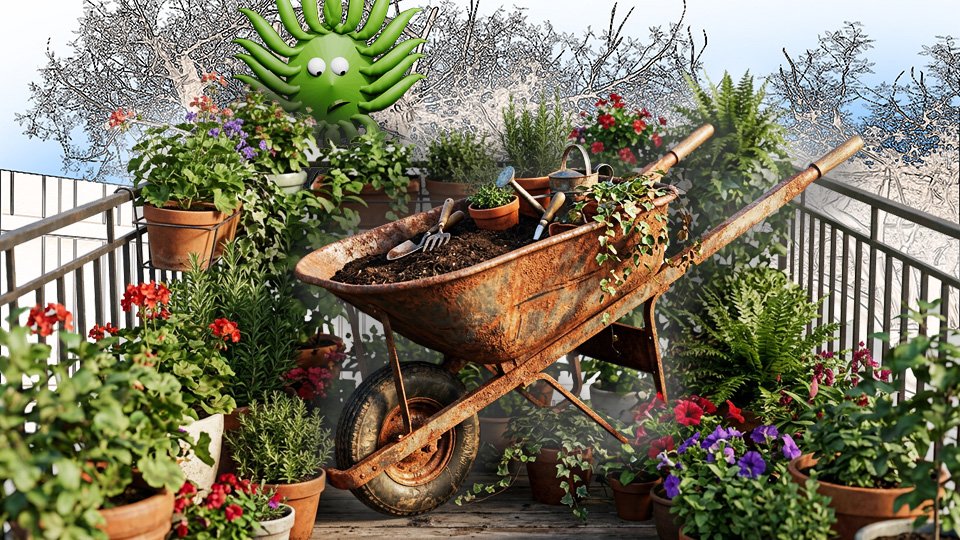
The Wheelbarrow: Do You Actually Need One?

A wheelbarrow is a significant purchase and a genuinely useful tool — for certain gardens. Here’s how to know if yours is one of them before you spend the money.

The wheelbarrow feels like essential garden equipment. It’s in every garden catalog. It appears in every garden scene in every movie. It is, visually, what “garden tool” looks like.

It is also bulky, expensive, takes up significant storage space, and is occasionally unnecessary for the garden you actually have. Tom Brownthumb bought one in his first season. It lived in the garage for two years before he had a use case large enough to justify it.

Here’s how to decide whether your garden needs a wheelbarrow — or whether a different tool does the same job at a fraction of the cost and a fraction of the storage footprint.

✅ When You Genuinely Need a Wheelbarrow

  • You’re moving bulk material. Cubic yards of compost, mulch, topsoil, or gravel. If you’re buying material by the cubic yard and moving it from the delivery pile to the beds, a wheelbarrow is the right tool. Doing this with buckets is technically possible and genuinely miserable.
  • You have a large garden. A quarter-acre or more of actively managed garden space generates enough material — weeds, prunings, harvest waste, compost inputs — that having a wheeled transport tool pays for itself in time and back strain.
  • You’re doing structural work. Building raised beds, laying paths, moving rocks, landscaping. The wheelbarrow is a construction tool as much as a garden tool, and for moving heavy material across a yard it has no peer.

❌ When You Probably Don’t

  • Small urban or suburban garden. A raised bed or two, a patio container setup, a modest plot. The material volumes are low enough that a garden trug or large bucket handles transport easily.
  • Limited storage. A wheelbarrow requires several square feet of dedicated storage space. If your shed is already full, the wheelbarrow lives outside and rusts faster than it earns its keep.

🪜 The Alternatives Worth Knowing

  • Garden trug. A flexible, lightweight tub that holds a surprising volume of material. Folds flat for storage. Handles compost, weeds, harvest, and small material transfers without effort. The right tool for most small-garden transport needs.
  • Garden cart. Four wheels instead of two, larger flat bed, more stable. Better for very heavy loads that would tip a wheelbarrow. Takes more storage space than a wheelbarrow.
  • Five-gallon buckets. Free from home improvement stores or cheap to buy. Stackable, versatile, zero storage footprint. For small-scale material moving, a pair of buckets is as efficient as a wheelbarrow for most tasks.

🔍 If You Do Buy a Wheelbarrow

  • Pneumatic tire over solid. A pneumatic (air-filled) tire rolls more easily over soft ground and uneven surfaces than a solid tire. Worth the slight maintenance tradeoff of occasional pressure checks.
  • Steel tray over plastic. More durable, handles sharp materials without cracking, longer lifespan overall.
  • Cubic capacity. A standard wheelbarrow holds about three to five cubic feet. Larger capacity means fewer trips but more weight per load. Match the size to how much you can realistically lift when full.

🛒 The Options

  • Marathon residential wheelbarrow — Pneumatic tire, steel tray, reliable residential workhorse. The solid starting point.
  • Gorilla Carts garden cart — Four-wheeled stability for heavy loads. Easier to use than a wheelbarrow for anyone with balance or strength concerns.
  • Flexible garden trug — The small-garden alternative. Holds more than it looks like it should, stores flat, handles most suburban garden transport tasks efficiently.

As an Amazon affiliate, I earn from each qualifying purchase. Thank you for supporting TangleWicket.

✨ The Short Version

Buy a wheelbarrow if you’re moving bulk material, have a large garden, or do structural landscape work. Consider a trug or cart if your garden is smaller and your storage is limited.

The wheelbarrow is a great tool. It is not a mandatory tool for every garden.

Wicket does not have strong feelings about wheelbarrows. Wicket is too small to push one.

📚 Related Reads


TangleWicket is part of the WhistleBump group – find the rest of the family at WhistleBump.com.

©2026 John D Reinhart/Tanglewicket.com – all rights reserved

Kneeling Pads and Garden Seats: Worth It or Not?

Kneeling in a garden without protection is a choice with consequences. Here’s what garden kneelers and seats actually do, which type makes sense for your situation, and why your knees will thank you.

Gardening happens close to the ground. Planting, weeding, transplanting, harvesting — most of the work requires either kneeling, squatting, or bending at a waist that does not appreciate the transaction.

For young gardeners with functional knees and flexible backs, this is a minor inconvenience. For everyone else, and for young gardeners who would like to remain comfortable well into their gardening future, the question of how you get down and back up again is worth thinking about.

The answer is not complicated. It’s a foam pad, a kneeler, or a seat — whichever matches your specific situation. Here’s how to choose.

🟫 The Foam Kneeling Pad

The simplest solution. A dense foam pad, typically half an inch to an inch thick, that sits between your knees and the ground. It cushions hard or rocky soil, provides minor insulation from cold ground, and costs almost nothing.

Best for: gardeners with healthy knees doing short-duration work in a relatively confined area. The pad moves with you, doesn’t take up storage space, and does its job without ceremony.

The limitation: it doesn’t help you get up. If your knees or back make the transition from kneeling to standing difficult, a foam pad addresses the kneeling discomfort but not the getting-up problem.

🪑 The Kneeler/Seat Combo

The folding metal-framed kneeler with padded surface that converts from a kneeling pad to a low seat by flipping it over. The side rails double as handles to assist getting up and down.

Best for: anyone for whom the transition between kneeling and standing is uncomfortable. The handles take significant load off knees and back during those transitions. The seat function provides an alternative to kneeling for tasks that can be done from a slightly higher position.

The better models hold several hundred pounds, fold flat for storage, and last for many seasons. The cheaper models bend under real use. This is one where the quality difference is meaningful.

🪑 The Garden Seat

A lightweight rolling or walking stool that keeps you off the ground entirely. You sit on the seat at a low height and move around without kneeling.

Best for: extended close work where kneeling is not practical for the duration. Row weeding, bed preparation work, seedling planting over a long stretch. Also the right tool for anyone for whom kneeling is genuinely not an option.

The limitation: only works on relatively flat, firm ground. Doesn’t function well on uneven terrain or very soft soil.

📏 The Honest Recommendation

If your knees and back are fine: a foam kneeling pad is sufficient and costs five dollars.

If getting up and down is difficult: the kneeler/seat combo with handles is the right tool and pays for itself in the first season.

If kneeling isn’t an option: a garden seat or rolling stool.

The underlying principle: gardening should be comfortable enough that you do it. Equipment that makes you more comfortable in the garden is equipment that gets you into the garden more often. That’s the whole point.

🛒 What to Buy

  • Thick foam kneeling pad — Simple, lightweight, effective for straightforward kneeling. The no-fuss starting point.
  • Abco kneeler and seat combo — Robust construction, useful handles, converts between kneeler and seat. The most versatile option for most gardeners.
  • Gardener’s rolling work seat — For extended row work or anyone for whom kneeling is not practical. Rolls smoothly on firm ground.

As an Amazon affiliate, I earn from each qualifying purchase. Thank you for supporting TangleWicket.

✨ The Short Version

Foam pad for simple situations. Kneeler/seat combo for anyone with knee or back concerns. Garden seat for extended work or when kneeling isn’t practical.

The ground is hard. Your knees are not getting younger. A twelve-dollar pad is worth it.

Tom Brownthumb gardened without knee protection for years. Tom Brownthumb’s knees have opinions about this that he now shares freely.

📚 Related Reads


TangleWicket is part of the WhistleBump group – find the rest of the family at WhistleBump.com.

31007

©2026 John D Reinhart/Tanglewicket.com – all rights reserved