
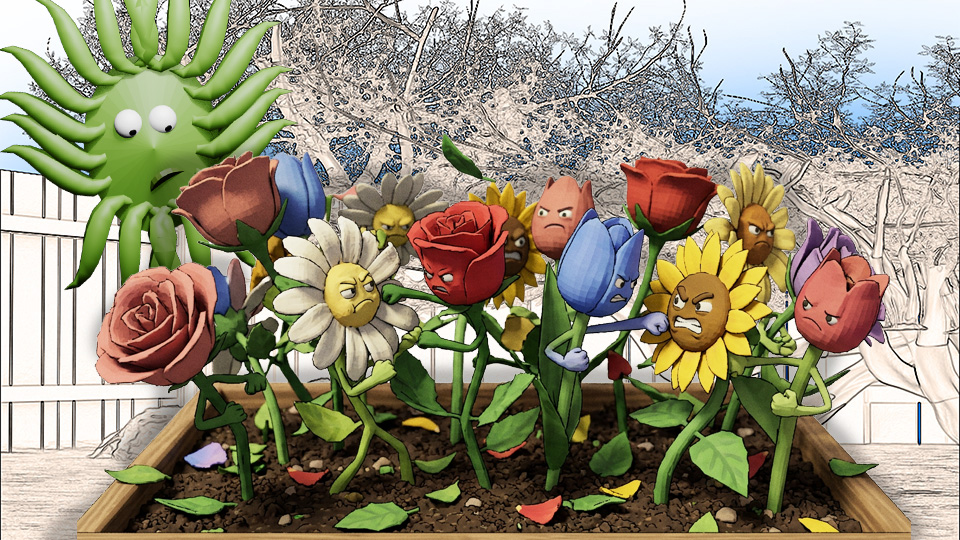
The beginner flower bed has a recognizable look. A marigold here, a zinnia there, a petunia that wandered off on its own, a gap where something didn’t germinate and was never replaced. It is identifiable at fifty feet. Not because the gardener lacked effort, but because nobody told them the three rules that separate “I planted some flowers” from “I planted a flower bed.”
Here are the three rules.
📐 Rule One: Tall in the Back, Short in the Front
A flower bed is a stage. The tall plants are the backdrop, the medium plants are center stage, and the short plants are the front row. If you plant tall things in front, they block everything behind them. If you plant short things in back, nobody sees them.
This sounds obvious but it requires planning before you plant, not after. Read the plant tag or seed packet before you buy, not after you’ve already put it in the ground.
General height zones: back of the bed — anything over 24 inches (gladiolus, tall zinnias, black-eyed Susans, coneflowers). Middle — 12 to 24 inches (marigolds, cosmos, salvia). Front — under 12 inches (alyssum, lobelia, dwarf marigolds, creeping phlox).
Within each zone, variation in height is fine. Uniformity is not the goal. The goal is visibility: every plant should be seeable from the front of the bed.
🎨 Rule Two: Mass, Don’t Scatter
A single marigold is a plant. Seven marigolds in a cluster are a statement. The beginner instinct is to space plants evenly across the entire bed, one of each variety, like a botanical inventory. The result looks random because it is random.
Plants read as color masses from a distance. A scattered handful of one color registers as noise. A grouped cluster of the same color registers as design. Plant in odd numbers — threes, fives, sevens — grouped together. Repeat those groups across the bed if the bed is large enough.
You do not need many varieties. Three to five varieties, planted in clusters, produce a more coherent look than fifteen varieties planted one-by-one.
🔲 Rule Three: Define the Edge
The edge of the flower bed is where the garden either looks cared-for or like it gave up. An undefined edge — where lawn grass drifts into the flower bed and the bed drifts back into the lawn — reads as neglect even when the plants themselves look good.
Define the edge with physical edging. This can be as simple as a plastic border pressed into the soil, or as substantial as a metal landscape edging that will last for years. What matters is the clean line: grass on one side, garden on the other, no ambiguity.
The line does not need to be straight. Curves are fine. What it cannot be is vague.
🌿 The Beginner’s Layout That Actually Works
Back row: a repeating group of tall zinnias or coneflowers every 18 inches. Middle: marigolds or cosmos in clusters of three to five. Front edge: alyssum or a low annual in a continuous ribbon along the edging line.
That’s it. Three plants, three heights, clean edge. It looks intentional because it is intentional. Tom Brownthumb calls this “the accidental professional” — it reads like you know what you’re doing even on your first attempt.
🛒 Gear Worth Having
GROWNEER 33FT Flexible Landscape Edging Kit with Stakes & Hammer — Everything you need to define the bed edge: edging, 30 galvanized spikes, and a hammer. No digging required.
EasyFlex No-Dig Landscape Edging, Stone-Look, 15-Foot Kit — The decorative option. Stone-look profile, anchors with spikes, easy to curve. Presentable from day one.
Fruivity 16-Variety Flower Seed Pack (Zinnia, Cosmos, Marigold, Coneflower, Bachelor’s Button & more) — Sixteen varieties in one purchase. Enough for back, middle, and front rows of a solid beginner bed.
As an Amazon affiliate, I earn from qualifying purchases. Thank you for supporting TangleWicket.
📖 Related Reads
- Soil: The Thing Beginners Ignore and Experts Obsess Over
- Why Raised Beds Are Worth Every Penny
- Mulch: The Weed’s Worst Enemy
TangleWicket is part of the WhistleBump group – find the rest of the family at WhistleBump.com.
36006
©2026 John D Reinhart/Tanglewicket.com – all rights reserved